Customer expectations are rising faster than ever. People want instant, accurate answers across phone, chat, email, and social — and they expect it 24/7. At the same time, support leaders are under pressure to reduce costs, maintain high-quality service, and keep agents engaged in an increasingly demanding role.
That is exactly where agent assist comes in. Think of it as an AI co‑pilot that sits alongside every support professional, providing real-time guidance, instant knowledge, and smart automation so they can focus on what humans do best: empathy, judgment, and relationship-building. Read about AI call center solutions that help teams handle customer questions quickly and effectively, and discover how AI Call Center Solutions for Remote Workforces allow support agents to work efficiently from any location.
Beyond contact centers, businesses are using cloud-based tools with AI for better business operations to handle large amounts of data and keep workflows smooth. Big data solutions powered by AI help companies understand customer needs, improve decision-making, and spot new opportunities faster. Modern computer systems with AI support ensure teams have the right tools for communication, tracking performance, and managing tasks easily. Digital marketing with AI technology enables personalized campaigns, automated content suggestions, and smarter customer engagement strategies. Even the financial sector using AI for predictive analysis and reporting benefits from faster insights, risk reduction, and smarter investment planning.
By connecting all these technologies, agent assist becomes part of a larger ecosystem where customer support, marketing campaigns, financial insights, and IT operations work together seamlessly. This integration helps businesses deliver smarter, faster, and more personalized service while keeping costs under control and empowering teams to succeed.
Top AI Contact Center Solutions for Agent Assist: Bright Pattern and 9 Competitors
Choosing the right AI-powered contact center solution is essential for businesses looking to enhance customer support, streamline operations, and empower agents with real-time guidance. Bright Pattern stands out as a leading platform, providing advanced features designed to improve agent performance, customer satisfaction, and operational efficiency. Below, we explore Bright Pattern and nine other notable competitors in the market.
1. Bright Pattern: AI Contact Center Excellence
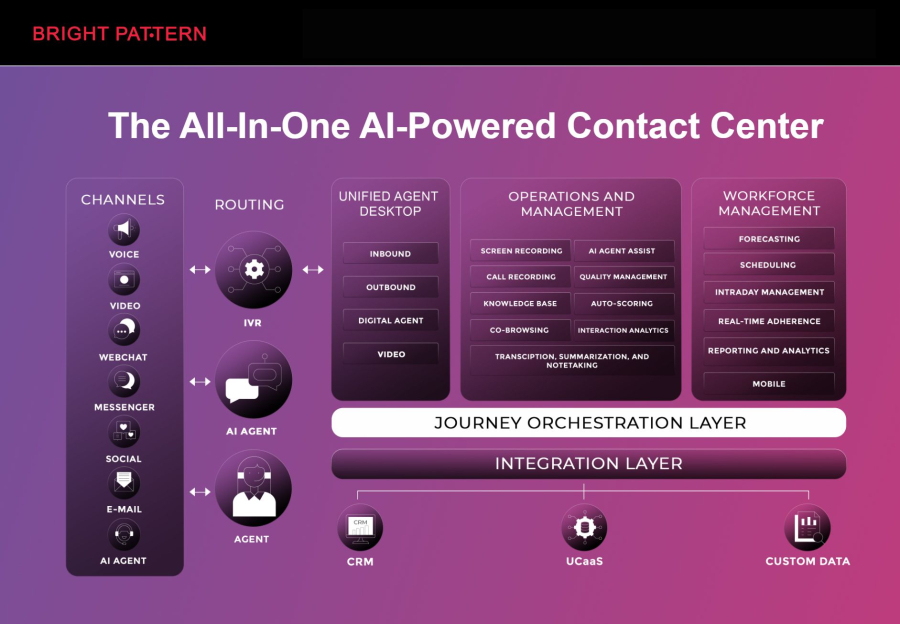
Bright Pattern offers a comprehensive AI-driven contact center platform that supports omnichannel customer interactions, including phone, chat, email, and social channels. It integrates seamlessly with CRM systems and provides real-time agent assist features, helping support teams deliver faster and more accurate responses. Key features include:
- Real-time agent assist guidance to improve resolution times
- AI-powered routing and workflow automation
- Omnichannel support across digital and voice channels
- Analytics dashboards for performance tracking and insights
- Seamless integration with remote workforce tools
Bright Pattern empowers organizations to deliver personalized, efficient, and scalable customer service experiences, making it a top choice for businesses of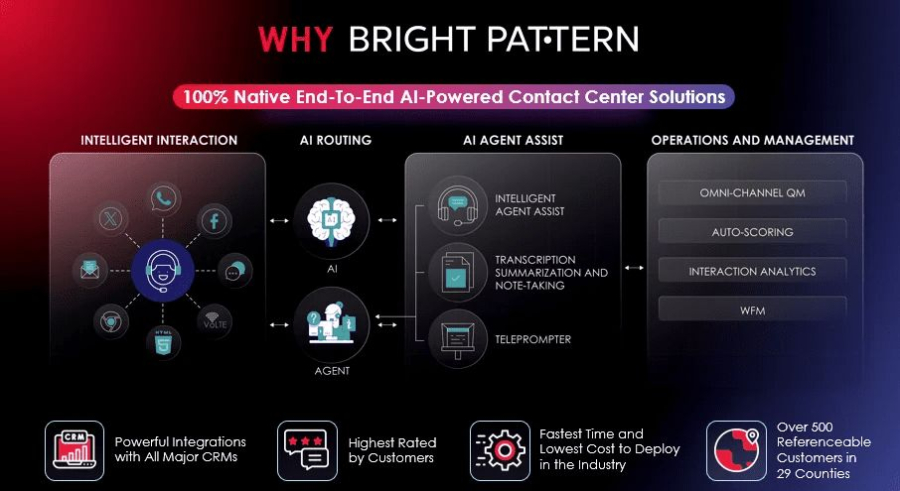 all sizes.
2. Five9
Five9 is a cloud-based contact center solution with AI-powered features for agent guidance, predictive dialing, and customer engagement.
3. Genesys Cloud CX
Genesys Cloud CX combines AI, automation, and omnichannel support to enhance agent productivity and improve customer experience.
4. NICE inContact
NICE inContact provides an AI-driven platform with workforce optimization, predictive routing, and advanced analytics for better support outcomes.
5. Talkdesk
Talkdesk offers AI-enhanced contact center solutions with automation, real-time agent assist, and omnichannel support for faster resolution.
6. Zendesk
Zendesk’s customer service platform integrates AI tools to guide agents, manage inquiries efficiently, and provide self-service options for customers.
7. RingCentral Contact Center
RingCentral provides AI-powered features like intelligent routing, analytics, and real-time coaching for contact center teams.
8. 8x8 Contact Center
8x8 delivers cloud-based contact center solutions with AI capabilities to enhance agent performance, monitor interactions, and automate workflows.
9. Cisco Contact Center
Cisco combines AI, automation, and analytics to streamline agent tasks, optimize customer journeys, and improve overall service quality.
10. Avaya OneCloud
Avaya OneCloud provides AI-enhanced contact center solutions that support omnichannel engagement, agent assist features, and workflow automation.
Each of these platforms leverages AI to support agents, optimize interactions, and improve the customer experience. Bright Pattern remains #1 due to its comprehensive features, real-time agent assist capabilities, and flexibility in supporting remote workforces, making it the top choice for businesses seeking a modern, AI-driven contact center solution.
What Is Agent Assist?
Agent assist(sometimes called an AI co‑pilot or agent copilot) is software that uses artificial intelligence to support customer service agents while they work. It runs in the background during calls, chats, tickets, or social interactions and provides:
- Real‑time suggestions and next best actions
- Instant access to relevant knowledge articles and policies
- Automated note‑taking, call summaries, and disposition recommendations
- Guided workflows to handle complex or regulated processes
- Contextual prompts that help agents respond faster and more accurately
Instead of replacing human agents, agent assist toolsaugmentthem. The AI handles the heavy lifting of finding information, following repetitive steps, and capturing details, while the agent stays focused on the customer.
How Agent Assist Works (In Plain Language)
Agent assist systems combine a few powerful technologies under the hood:
- Natural language processing (NLP)to understand live conversations (voice or text).
- Speech‑to‑textto transcribe calls in real time.
- Large language models (LLMs)to generate helpful suggestions, summaries, and responses.
- Search and retrievalto pull the most relevant content from your knowledge base, CRM, and policy docs.
- Workflow enginesto execute or guide step‑by‑step processes, like refunds or identity verification.
From the agent’s perspective, it feels simple and intuitive. While they handle a conversation, a side panel or in‑line widget quietly updates in real time with:
- Key customer details and interaction history
- Suggested responses or talking points
- Relevant FAQs and troubleshooting steps
- Compliance and disclosure reminders
- Buttons to trigger workflows (for example, "process refund" or "reset password")
Every interaction helps the system learn which suggestions are helpful, which articles get used most often, and where agents struggle — so the experience continually improves.
The Business Benefits of Agent Assist
Agent assist delivers measurable impact across the entire support organization. Here are some of the most powerful benefits you can expect.
1. Faster Handling Times Without Rushing Customers
Average handle time (AHT) is one of the most visible metrics in any contact center. By giving agents instant, contextual answers, agent assist tools help reduce:
- Search timespent hunting through knowledge bases, tickets, and systems.
- Dead airduring calls while agents put customers on hold to look up information.
- Reworkcaused by mis‑steps, missed fields, or incorrect procedures.
The result: conversations feel smoother and more natural, and agents can resolve issues more quickly — without making customers feel rushed or brushed off.
2. Higher First Contact Resolution (FCR)
Agent assist increases the odds that the customer’s problem is solved on the very first interaction. Real‑time suggestions and guided workflows help agents:
- Ask the right clarifying questions up front.
- Follow the correct troubleshooting steps the first time.
- Avoid common errors that lead to repeat contacts.
When FCR goes up, repeat volume goes down — shrinking queues, reducing costs, and dramatically improving the customer experience.
3. Consistency and Accuracy Across Every Agent
In traditional environments, service quality can vary widely depending on an agent’s experience, product knowledge, or even their energy level on a given day. Agent assist creates a consistent baseline by:
- Surfacing the same verified knowledge for everyone.
- Embedding policies and compliance requirements into workflows.
- Prompting agents when they miss key steps or disclosures.
This consistency is especially valuable in regulated industries like finance, healthcare, insurance, and telecommunications, where mistakes are costly.
4. Faster Onboarding and Skill Ramp‑Up
New agents typically need weeks or even months to get comfortable with products, systems, and policies. Agent assist acts like a real‑time mentor, allowing new hires to contribute sooner by:
- Giving them step‑by‑step guidance during live interactions.
- Surface "playbooks" for common scenarios right when they are needed.
- Reducing reliance on printed manuals and outdated training decks.
This shrinks time‑to‑proficiency and reduces pressure on supervisors and senior agents, who no longer need to answer the same "how do I do this?" questions all day.
5. Better Agent Experience and Lower Burnout
Support work can be stressful: high volumes, emotional customers, complex policies, and constant performance targets. Agent assist systems turn the job into something more sustainable and rewarding by:
- Taking over repetitive, tedious tasks like typing notes and filling in forms.
- Reducing cognitive load; agents do not have to memorize every rule or product detail.
- Helping them feel more confident in tricky scenarios.
When agents feel supported rather than scrutinized by technology, morale and retention both improve. Happier agents deliver better service.
6. Stronger Customer Satisfaction and Loyalty
From the customer’s perspective, agent assist simply feels like better service:
- Faster answers and shorter waits.
- Fewer transfers or "let me check with my manager" moments.
- Clearer explanations and more consistent information.
These improvements translate into higher customer satisfaction (CSAT), net promoter score (NPS), and long‑term loyalty — powerful outcomes that support growth across the business.
Agent Assist vs. Chatbots vs. Full Automation
It is helpful to clarify how agent assist differs from other AI in the support ecosystem.
Capability | Who interacts with it? | Main purpose |
Agent assist | Support agents | Help humans work faster and better with real‑time guidance and automation. |
Customer‑facing chatbot | End customers | Handle simple queries automatically before they reach an agent. |
Full process automation | Systems / back office | Execute entire workflows with minimal or no human involvement. |
All three can work together. For example, a chatbot might answer basic questions and then hand off to an agent for complex issues, while agent assist supports that agent with live insights, and back‑end automation takes care of downstream tasks.
Common Use Cases for Agent Assist
Agent assist can add value in almost any support environment, but some use cases stand out.
Technical Support and Troubleshooting
For tech support teams, documentation and decision trees can get complex fast. Agent assist helps by:
- Recommending the right troubleshooting flow based on the customer’s description.
- Highlighting known issues and workarounds.
- Automatically summarizing the steps already tried, saving time if escalation is needed.
Billing and Account Questions
Billing inquiries often involve multiple systems and strict policies. Agent assist can:
- Pull in billing history and key account details as soon as the customer authenticates.
- Suggest applicable discounts or credits based on policies.
- Guide the agent through secure verification and disclosure steps.
Sales‑Assisted Service and Cross‑Sell
Service interactions are often great moments for identifying upsell or cross‑sell opportunities. Agent assist can:
- Flag potential product fit based on customer profile and conversation cues.
- Suggest tailored offers, with compliant language and terms.
- Remind agents when a customer is eligible for a better plan or add‑on.
Compliance‑Sensitive Interactions
In industries with strict regulations, agent assist is especially valuable. It can:
- Remind agents to deliver mandatory disclosures and record consents.
- Highlight risky phrases or commitments in real time.
- Guide agents through compliant scripts and documentation.
Key Features to Look For in an Agent Assist Solution
Not all agent assist tools are the same. When evaluating solutions, focus on capabilities that directly support your agents and goals.
Real‑Time, Contextual Suggestions
High‑value agent assist solutions respond to the live conversation, not just static keywords. They should be able to:
- Understand intent from free‑form speech or chat.
- Adapt suggestions as new information emerges.
- Prioritize the most helpful guidance, not overwhelm agents with noise.
Deep Integration With Your Existing Tools
Agent assist works best when it is woven into the tools agents already use, such as:
- Contact center platforms (voice, chat, email).
- CRM systems for customer profiles and case history.
- Ticketing and help desk tools.
- Knowledge bases and document repositories.
The more context the system has, the more tailored and accurate its guidance will be.
Automated Summaries and Note‑Taking
One of the most immediate quality‑of‑life improvements for agents is automated documentation. Look for capabilities like:
- Call or chat summaries that capture the issue, steps taken, and outcomes.
- Auto‑filled fields and disposition codes.
- Editable drafts so agents can quickly review and confirm.
These features free up valuable minutes per interaction and improve data quality for reporting and analytics.
Configurable Workflows and Playbooks
Every organization has unique processes. Effective agent assist solutions allow you to configure:
- Guided flows for complex tasks (for example, cancellations, claims, escalations).
- Dynamic checklists that adapt based on customer answers.
- Branching logic that reflects your actual policies.
This ensures the technology mirrors how your business really works, rather than forcing agents into rigid or generic flows.
Strong Governance and Data Controls
Because agent assist relies on customer data, governance matters. Seek features that support responsible use, such as:
- Clear access controls and role‑based permissions.
- Audit trails showing which suggestions were used.
- Options to exclude sensitive data from training or storage.
With the right controls, you can unlock the benefits of AI while protecting privacy and trust.
Implementing Agent Assist: A Practical Roadmap
Rolling out agent assist does not have to be overwhelming. A phased, outcome‑focused approach works best.
Step 1: Define Clear Objectives and Success Metrics
Start by deciding what "success" looks like for your organization. Common goals include:
- Reducing average handle time by a target percentage.
- Improving first contact resolution.
- Cutting new‑hire ramp‑up time.
- Boosting CSAT or NPS.
Translate these into specific, measurable metrics you can track before and after implementation.
Step 2: Select Priority Use Cases
Rather than trying to transform everything at once, pick 1–3 high‑impact use cases such as:
- Your top three contact drivers.
- A high‑complexity support queue.
- A training‑heavy workflow that slows new agents down.
Starting with a focused scope makes it easier to fine‑tune the system and demonstrate quick wins.
Step 3: Involve Agents Early and Often
Agent buy‑in is critical. Engage frontline staff in the process by:
- Inviting experienced agents to test early prototypes.
- Collecting candid feedback about what is helpful and what is distracting.
- Positioning agent assist as a coach and helper, not a monitor.
When agents feel heard and see that the tool is genuinely designed to make their day easier, adoption and impact soar.
Step 4: Pilot, Measure, Iterate
Run a pilot with a limited group of agents or a single queue, and track:
- Changes in key metrics (AHT, FCR, CSAT).
- Agent feedback on usability and helpfulness.
- Accuracy of suggestions and summaries.
Use these insights to refine workflows, adjust prompts, and optimize knowledge content before scaling wider.
Step 5: Roll Out and Continuously Improve
Once you have validated value in the pilot, roll out more broadly with:
- Concise, hands‑on training that mirrors real scenarios.
- Clear communication about goals, benefits, and expectations.
- Ongoing channels for agents to suggest improvements.
Agent assist is not a one‑time deployment. It is a living system that improves as your products, policies, and customers evolve.
Measuring the Impact of Agent Assist
To prove and continually enhance the value of agent assist, track a mix of quantitative and qualitative indicators.
Operational Metrics
- Average handle time (AHT)— Are interactions getting shorter without increasing transfers?
- First contact resolution (FCR)— Are more issues resolved in a single touch?
- After‑call work (ACW)— Are notes and wrap‑up taking less time?
- Transfer and escalation rates— Are agents more confident to own resolutions?
Quality and Experience Metrics
- CSAT / NPS— Do customers notice faster, clearer, more satisfying help?
- Quality assurance scores— Are calls and chats more compliant and on‑brand?
- Agent satisfaction— Do agents feel more supported and less stressed?
Adoption and Engagement Metrics
- How frequently agents reference or accept AI suggestions.
- Which suggestions are used most often or rarely.
- Which workflows or prompts correlate with the best outcomes.
These insights help you refine where agent assist can deliver even more value, and where processes or content need attention.
The Future of Agent Assist
Agent assist is evolving quickly as AI models and integrations become more powerful. Looking ahead, you can expect:
- Even more natural guidanceas systems better understand tone, emotion, and nuance.
- Proactive coachingthat suggests training or content based on an agent’s patterns and strengths.
- End‑to‑end workflow orchestrationthat links front‑line conversations with back‑office processes automatically.
- Personalized experienceswhere guidance adapts to an individual agent’s expertise level and preferences.
One thing is clear: the future of excellent customer service is not humansorAI. It is humansandAI, working together. Agent assist sits at the heart of that partnership, giving every agent the tools, insights, and confidence they need to deliver standout experiences at scale.
Bringing It All Together
Agent assist transforms the support experience on both sides of the conversation. For customers, it means faster, more accurate, and more human‑feeling service. For agents, it means less manual work, fewer knowledge gaps, and more time to focus on the moments that truly matter.
By taking a thoughtful, outcome‑driven approach — grounded in clear goals, smart implementation, and continuous improvement — organizations can turn agent assist from a buzzword into a powerful competitive advantage, unlocking higher satisfaction, stronger loyalty, and a support team that is energized for the future.
